Publications
2026
-
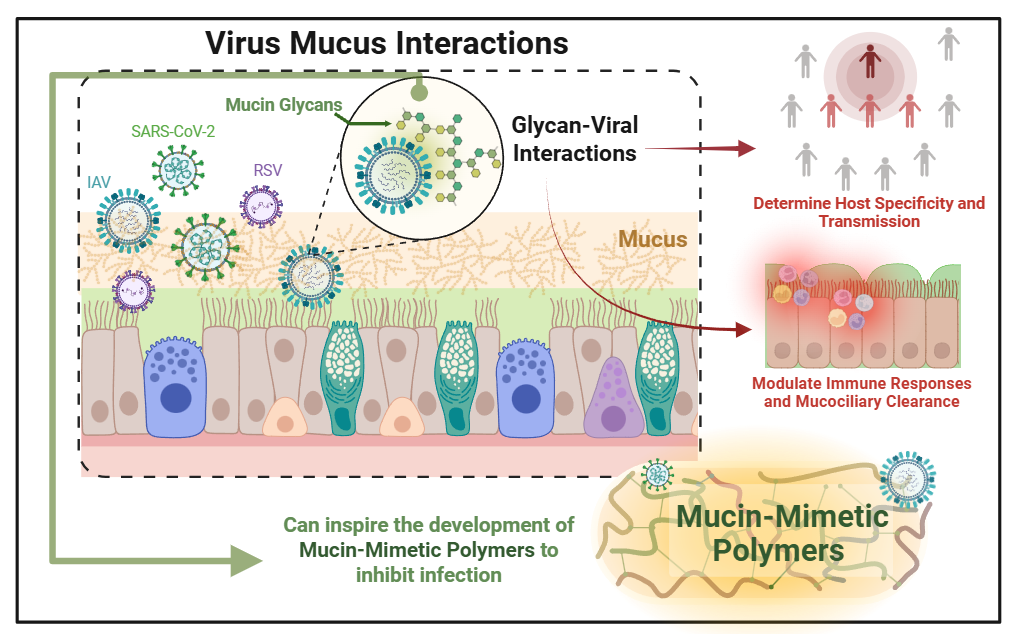 Mechanisms for Physicochemical Interaction between Mucus and Respiratory VirusesIshita Sanjay Hiremath, and Caroline E WagnerACS Biomaterials Science & Engineering 2026
Viral infections of the respiratory tract, including those caused by respiratory syncytial virus, influenza, and coronaviruses, constitute a significant global public health burden. Central to the pathogenesis of these infections are the interactions between viruses and host mucosal barriers, particularly the complex glycoproteins known as mucins that are the primary constituents of mucus. Mucins function not only as physical barriers but also as immune modulators, with their glycan chains playing critical roles in viral recognition and binding processes. These viral-mucin interactions determine host specificity, influence transmission dynamics, and regulate immune responses. Conversely, viruses can alter mucus composition and compromise mucociliary clearance mechanisms. This review first examines the structural and functional properties of mucins, followed by a comprehensive analysis of the complex interactions between respiratory viral surface proteins and mucins, including virus-induced perturbations to airway mucus secretion. We summarize current knowledge of viral-mucin interactions to provide insights into the potential development of mucin-mimetic polymers for targeted viral engagement, with applications ranging from viral detection to infection inhibition. Additionally, we discuss biophysical methodologies for investigating interactions between viruses and glycans.
@article{hiremath2026mechanisms,
  title = {Mechanisms for Physicochemical Interaction between Mucus and Respiratory Viruses},
  teaser = {Pub2.png},
  author = {Hiremath, Ishita Sanjay and Wagner, Caroline E},
  journal = {ACS Biomaterials Science \& Engineering},
  volume = {12},
  number = {1},
  pages = {13--30},
  year = {2026},
  doi = {10.1021/acsbiomaterials.5c00425},
  pmid = {41365623},
  publisher = {American Chemical Society}
}
2022
-
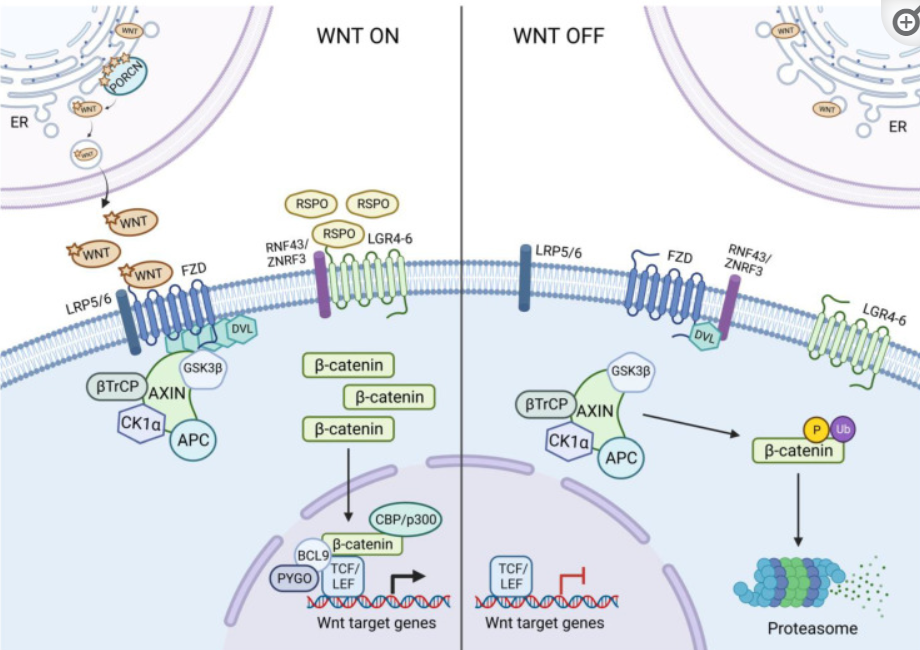 The multidimensional role of the Wnt/β-catenin signaling pathway in human malignanciesIshita S Hiremath, Arul Goel, Sudha Warrier, and 3 more authorsJournal of Cellular Physiology 2022
Several signaling pathways have been identified as important for developmental processes. One of such important cascades is the Wnt/β-catenin signaling pathway, which can regulate various physiological processes such as embryonic development, tissue homeostasis, and tissue regeneration; while its dysregulation is implicated in several pathological conditions especially cancers. Interestingly, deregulation of the Wnt/β-catenin pathway has been reported to be closely associated with initiation, progression, metastasis, maintenance of cancer stem cells, and drug resistance in human malignancies. Moreover, several genetic and experimental models support the inhibition of the Wnt/β-catenin pathway to answer the key issues related to cancer development. The present review focuses on different regulators of Wnt pathway and how distinct mutations, deletion, and amplification in these regulators could possibly play an essential role in the development of several cancers such as colorectal, melanoma, breast, lung, and leukemia. Additionally, we also provide insights on diverse classes of inhibitors of the Wnt/β-catenin pathway, which are currently in preclinical and clinical trial against different cancers.
@article{hiremath2022multidimensional,
  title = {The multidimensional role of the Wnt/$\beta$-catenin signaling pathway in human malignancies},
  teaser = {Pub1.png},
  author = {Hiremath, Ishita S and Goel, Arul and Warrier, Sudha and Kumar, Alan Prem and Sethi, Gautam and Garg, Manoj},
  journal = {Journal of Cellular Physiology},
  volume = {237},
  number = {1},
  pages = {199--238},
  year = {2022},
  publisher = {Wiley Online Library}
}